

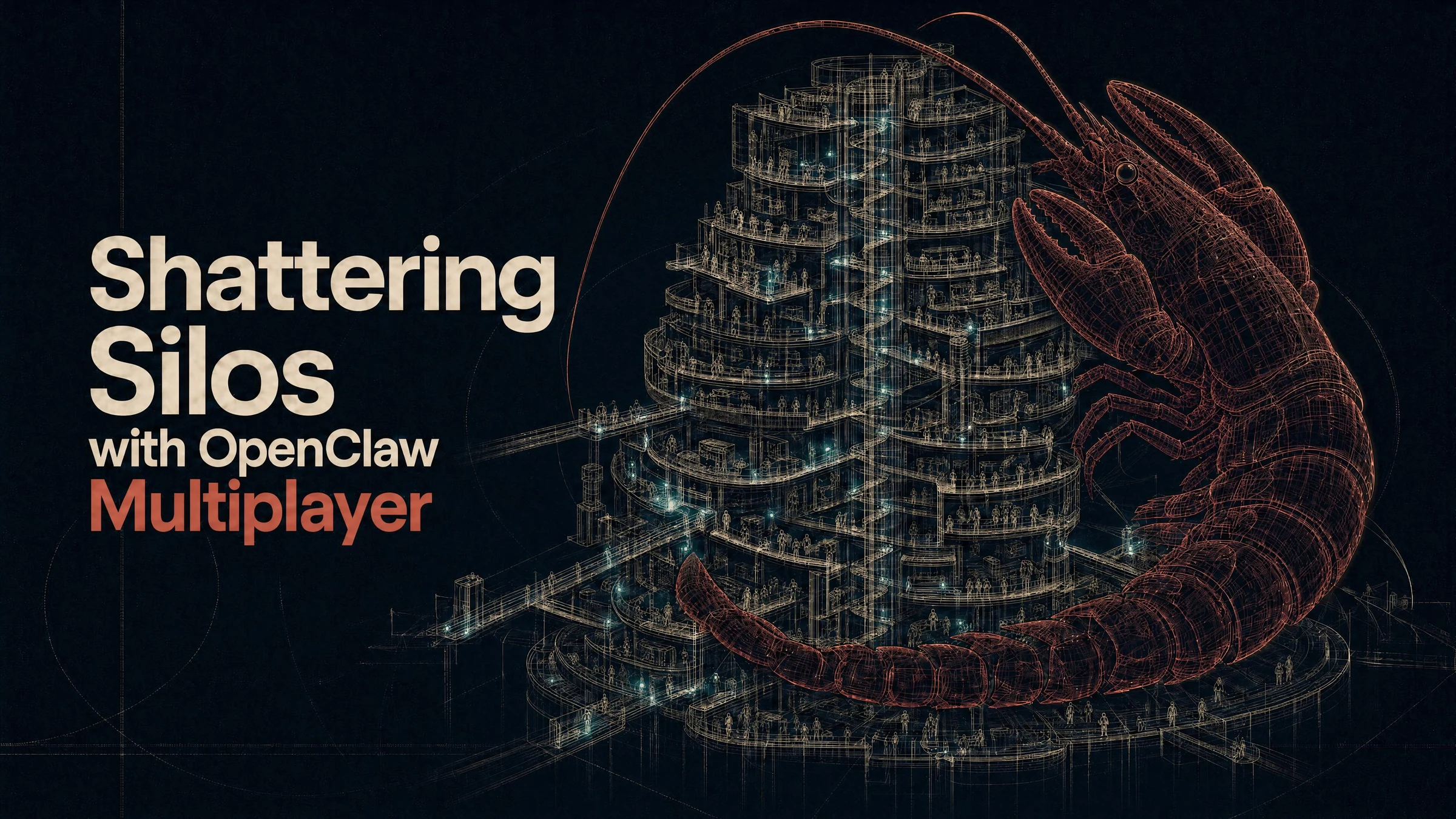
Our feature shows you exactly how to escape your silo.
Are you an Engineer, Product Manager, or perhaps Head of IT who has struggled with the immense difficulties of siloing at your organization? With Marketing, Sales, QA, Product, Engineering, DevOps, and every other department or team working in their own silo, on their own agent, even with their own model?
Do you wonder about your silo? Asking why you’re here, who built the silo, why everything outside the silo is as it is. Wondering when it will be safe to leave your silo, and whether or not that day is today?
Today is that day.
OpenClaw Multiplayer has arrived, and we’ve brought a wrecking ball.
Silos got worse with AI!
Tech spent decades trying to get people in organizations to work better together, to communicate across levels and departments, to share knowledge and eliminate organizational silos that have been the bane of every enterprise.
And now everybody has their own AI agent, set to task doing its own thing.
Engineering has theirs, Product has theirs, Marketing, Sales, QA, DevOps, and whatever department is responsible for putting inspirational quotes on the walls all have their own agents, models, and ways of doing things.
One is using GPT, another Claude, someone in Accounting is using a local model on a machine that sounds like a commercial leaf blower. They are all prompting independently, developing their own disparate context, and getting very different results. We’ve invented a new and exciting way not to talk to each other!
The trouble begins when these people actually need to collaborate. That’s when someone has to explain what they did, what they told their agent, what it produced, and how they got there. Their colleague then feeds some rough approximation of that context into their own agent and hopes the important bits survive. They often don’t.
Context gets lost. Instructions are mangled. Changes collide. The pact to coordinate gets broken.
We know this problem well at the OpenClaw Foundation. We have more than a dozen full-time Maintainers on staff and a substantial community of contributors, many of whom are AI-native developers producing enormous volumes of PRs, and keeping everyone aligned can be a colossal pain.
So we built Multiplayer.
Two laptops, one agent, and a very large Statue of Liberty
We brought OpenClaw Multiplayer to GitHub Universe in San Francisco to deliver live demonstrations to attendees.
Among the reactions were 11 spontaneous, verbal “Oh my god” declarations. We counted. Other favorites included “Wow” and “If you are free, how is your software so powerful?”
The demonstration was simple. Two laptops connected to the same OpenClaw agent, with a large display showing a live 3D rendering of Fort Mason, where we were standing. We’d invite an attendee to choose a famous landmark from somewhere outside San Francisco.
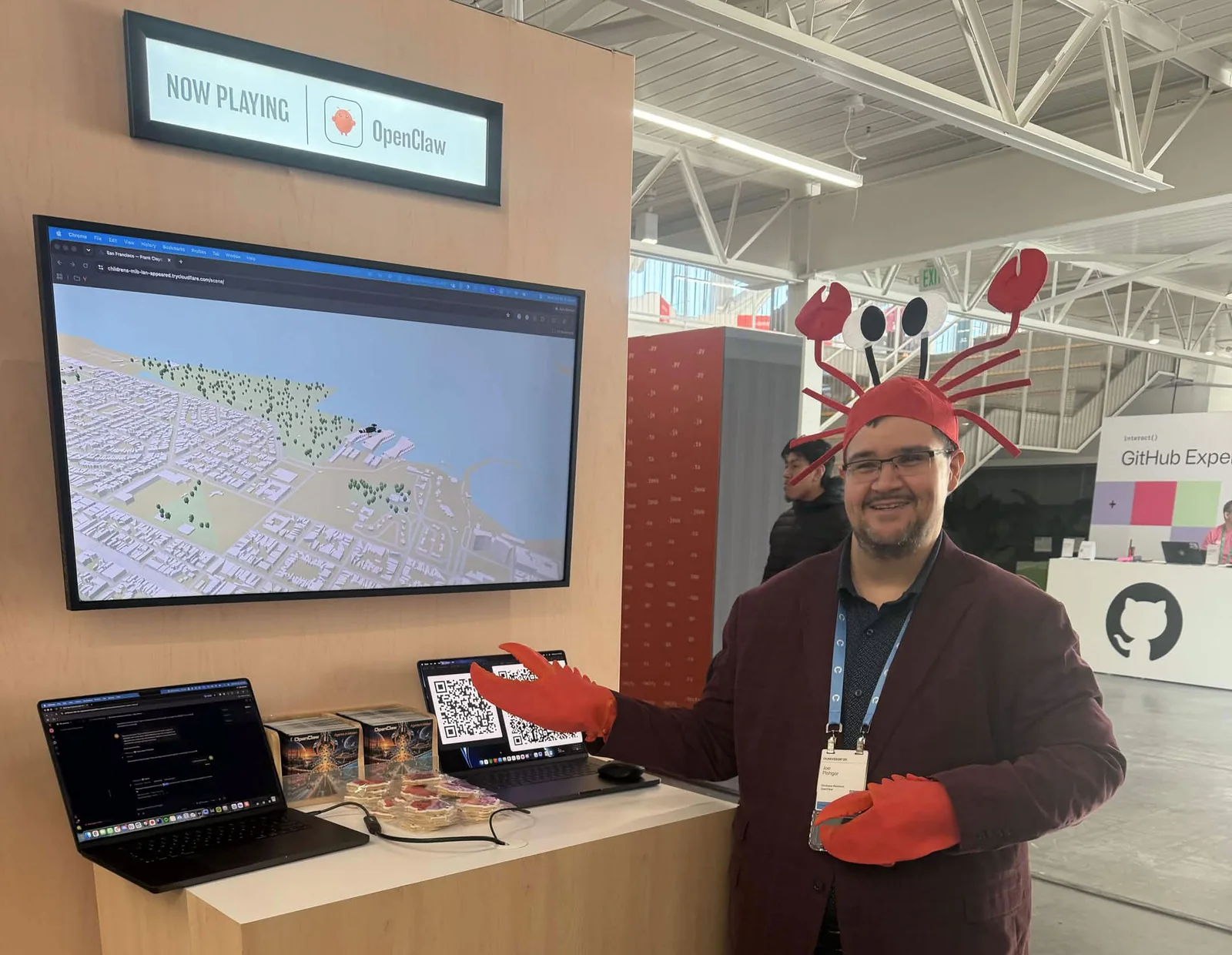
The Statue of Liberty was a popular choice. We’d ask them to type “Add the Statue of Liberty” into the first laptop.
Before they hit Enter, we’d point to the second laptop, where their prompt was appearing live as they typed it. Every letter. Every word. Same workspace. Same agent. Two different people.
They’d press Enter, and a few moments later, the Statue of Liberty would materialize in front of Fort Mason, looking lumpy and low-poly, but recognizable.
Then we’d move to the second laptop and type “Make that three times bigger.”
The prompt appeared live on the first laptop, and after submitting it, our newly transplanted Statue of Liberty tripled in size. Here’s the interesting part: We didn’t have to explain which object we meant. We didn’t have to copy over the previous prompt, summarize the conversation, or ask the agent to reconstruct somebody else’s work.
We were two people working together, interacting with the same agent, with the same context, making changes to the same thing.
And because Multiplayer coordinates requests through a shared queue, we could see when the agent was busy rather than blindly throwing conflicting instructions at it.
That’s when the “Oh my god” reactions tended to happen. Not because we’d rendered a giant Statue of Liberty. People were realizing what this could mean for their own work.
Think about the last time Product and Engineering had a disagreement.
Actually, don’t. We only have so much time.
Consider the ordinary process of a product manager asking an engineer to build something.
The PM describes what they want. The engineer interprets it. Work gets done. The PM reviews it and says that’s not quite what they meant. The engineer explains why they built it that way. The PM clarifies. The engineer points out that the new requirements conflict with something agreed upon last Tuesday.
Somewhere along the way, collaboration becomes a court proceeding, with Product acting as plaintiff and Engineering as defendant.
Now throw independent AI agents into that equation, each with its own context and understanding of what’s being built. A recipe for disaster and friction we all know too well.
With Multiplayer, those people can work in the same environment, contributing to the same agent, watching one another’s instructions develop, and making adjustments together.
Engineering, Product, QA, DevOps, and nontechnical colleagues can participate without reconstructing entire conversations or playing an elaborate game of telephone between agents.
Everybody is working with the same context.
Multiplayer isn’t going to cure bad management or the guy who keeps scheduling meetings to discuss whether we should schedule more meetings, but it addresses an enormous source of organizational friction.
OpenClaw Multiplayer has the potential to obliterate organizational silos.
By giving people the ability to actually work together.
We’re already using it ourselves.
At the Foundation, we’ve had around 50+ people collaborating in the same shared environment, and we’re continuing to push what Multiplayer can do.
We’re expanding and improving the experience, including through our Focus Week initiatives, where maintainers and contributors coordinate around specific project priorities.
The industry has spent an extraordinary amount of time discussing what one person can accomplish with an AI agent. How much code one engineer can produce. How quickly someone can draft requirements. How many hours can be saved. Fine. Great, even.
But what happens when all those individually productive people can collaborate without constantly losing and reconstructing context?
At the recent conference, you could see the wheels turning. Attendees would watch the demonstration and immediately begin mentally applying Multiplayer to some particularly miserable process at their own organizations.
We didn’t have to tell them what their use case was - they already knew.
Oh, and it’s free.
One of my favorite questions during demoing was, “If you are free, how is your software so powerful?”
OpenClaw is developed by a nonprofit, open-source foundation. It’s MIT licensed, model-agnostic, and built to be customized. You bring your own model. OpenAI, Qwen, Claude, something local, whatever suits you. Run OpenClaw on your own machine, a VPS, or wherever you prefer. Fork it. Modify it. Extend it. Tear it apart and put it back together in some new and grotesquely interesting configuration.
You’re welcome to grab it. With 83,000 forks, quite a few have!
We built something that solves a problem we’ve experienced ourselves, and we’re making it available for anybody to use. That includes this new feature!
Today is the day.
AI has changed so much about the work people do, but considerably less attention has been paid to how people do that work together. And in the process, we’ve built ourselves new silos, each equipped with an extraordinarily intelligent agent that has no idea what the agent in the next silo over is doing.
Multiplayer gives people a shared place to work, a shared agent, and the ability to collaborate without sacrificing the context that makes the work meaningful.
It’s free, it’s open source, and you’re welcome to make it your own.
Decades of corporate initiatives, consultants, and management philosophies have tried to break down organizational silos. OpenClaw Multiplayer actually does it.
Find out more about Multiplayer here.
Time to leave your silo. Today is that day.