

OpenClaw has inspired hundreds of thousands of developers and builders to run agents on their own hardware, and on their terms.
But we know that getting this experience running has not always felt easy.
We’ve heard the feedback that even technically experienced users spend more than 30 minutes wrestling with setup before they can have a working agent. That is not the experience we want. We want everyone’s first experience with OpenClaw to be as intuitive as possible.
In June, we launched the Windows App installer, bringing an easier, more familiar onboarding experience to users not quite ready to interface with the terminal. Today, we are bringing this same native app UI to macOS users.
We are also making the Windows setup experience even simpler by offering frictionless setup of a local model tuned to your hardware on Windows PCs with NVIDIA RTX.
Install and onboard like any other app, now on macOS
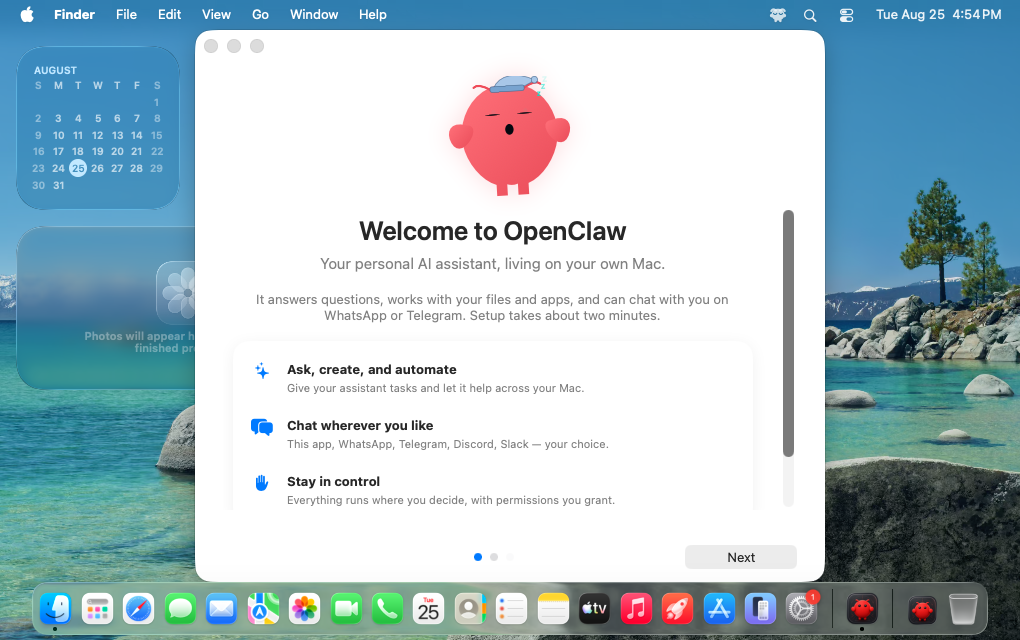
You can now download OpenClaw and click through a familiar app installation UI on any macOS desktop, then get right to building with agents without ever touching the terminal.
We’ve been testing this in clean environments to surface and repair the spots where connections and authentications tend to fail. As always, reach out if you run into any issues.
Automatic model detection on macOS
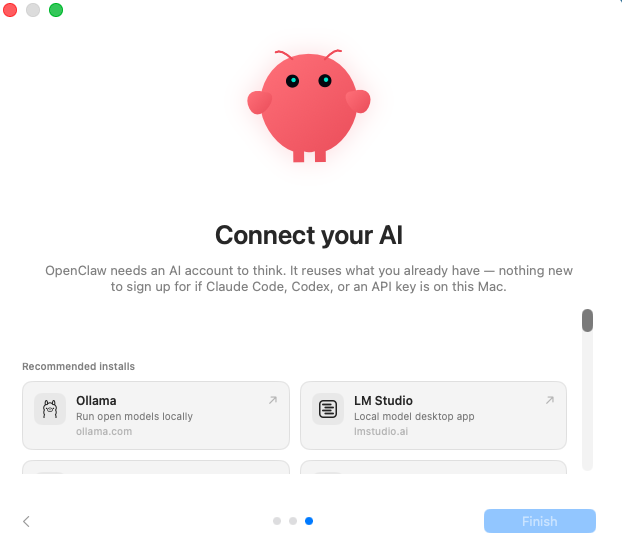
Model setup is another place people run into a wall of configuration. If you already have working AI access (like an existing Claude, Codex, or Ollama configuration), OpenClaw can detect and verify the connection point for you on macOS. Power users can still choose their own models, providers, local inference, gateways, and advanced configuration.
Frictionless local model setup on Windows for NVIDIA RTX
On Windows PCs with NVIDIA RTX GPUs, OpenClaw takes this one step further. Rather than just connecting to model access you already have, it can also detect your NVIDIA hardware during onboarding and suggest optimized local models to run, without existing configuration.
During onboarding, it can do this automatically on any NVIDIA RTX GPU with at least 24GB of memory, enough to run 30B-class models entirely on your own machine.

This works across Windows-based NVIDIA PCs, including NVIDIA GeForce RTX and NVIDIA RTX PRO GPUs, with support also planned for NVIDIA RTX Spark and NVIDIA DGX Station for Windows.

Developers and AI enthusiasts are already using our free, open-source platforms to build, customize, and run autonomous agents on their own devices. Making local model setup simpler opens that to a much broader group.
Running models locally also means OpenClaw can reach powerful AI capabilities directly on the device: more control over your data, and private, unmetered intelligence without leaning on cloud inference for every interaction.
Building toward more secure agents
Local compute is only part of the equation. Autonomous agents interact with files, tools, applications, and services, which makes control over what an agent can access and do especially important.
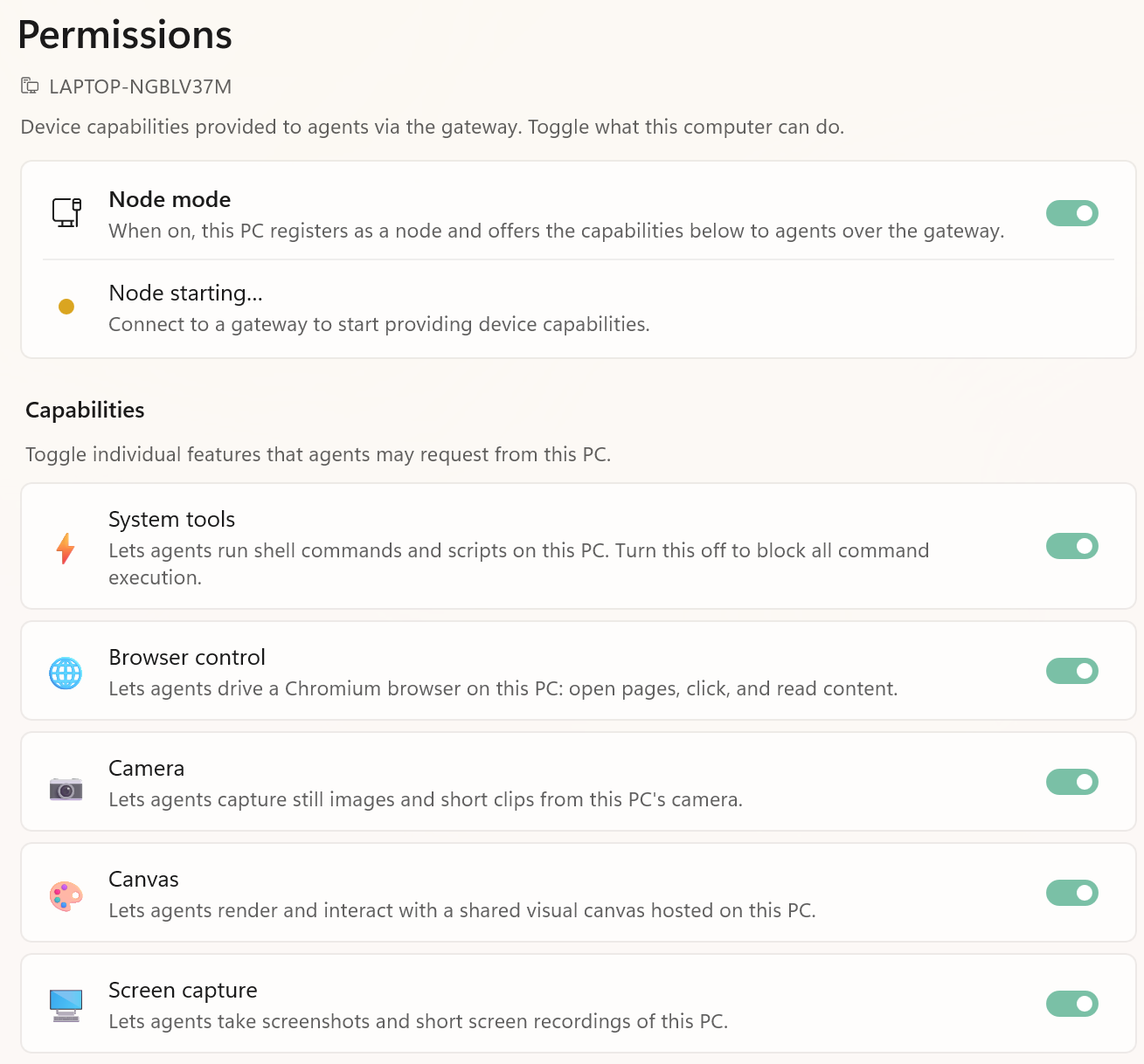
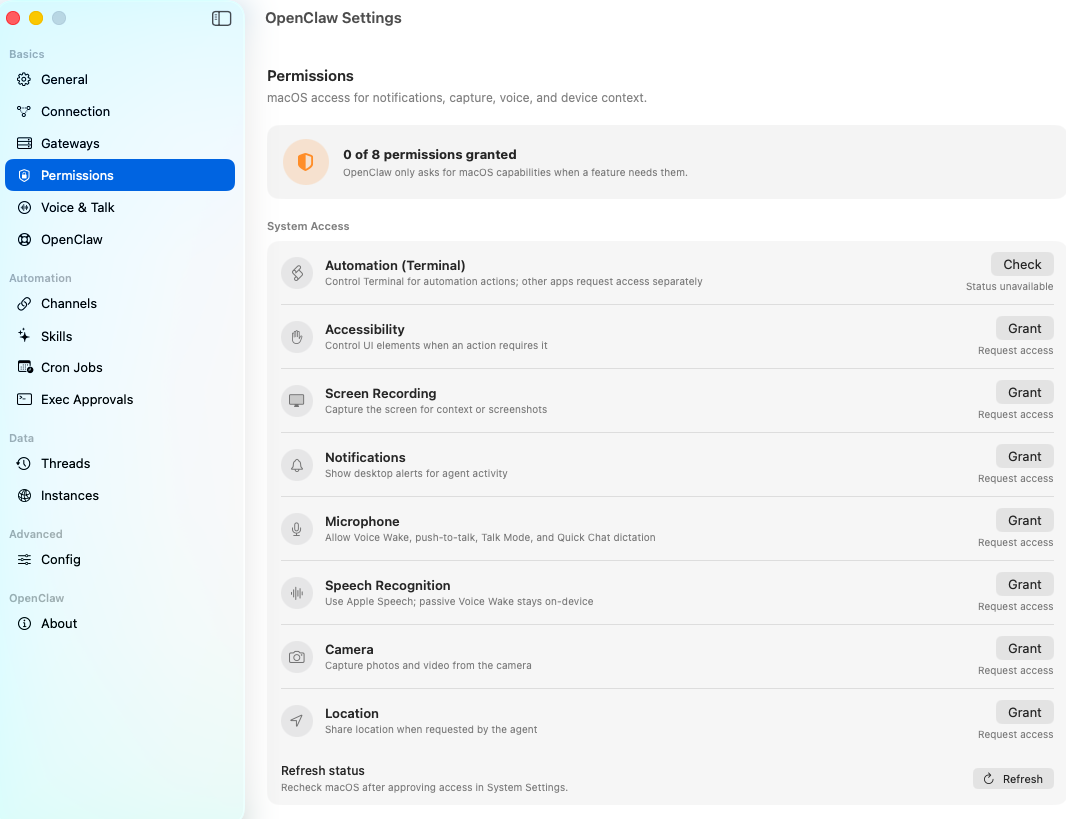
On Windows, we’ve been offering an easy-to-understand permissioning experience that tells you what OpenClaw is asking to access, why it needs that access, and gives you an easy way to change your mind later.
On macOS, we’re now offering the same.
We’ve likewise been working with Microsoft and NVIDIA toward an agent experience that combines open agent software, NVIDIA-powered local compute, and Windows security and governance.
The Windows OpenClaw App gives you an interface for configuring how OpenClaw operates on your device, including permissions and containment options. Microsoft Execution Containers (MXC) are already available today as a free open-source project, with general availability expected this fall. These provide the underlying containment layer, designed to isolate agent activity and enforce those controls.
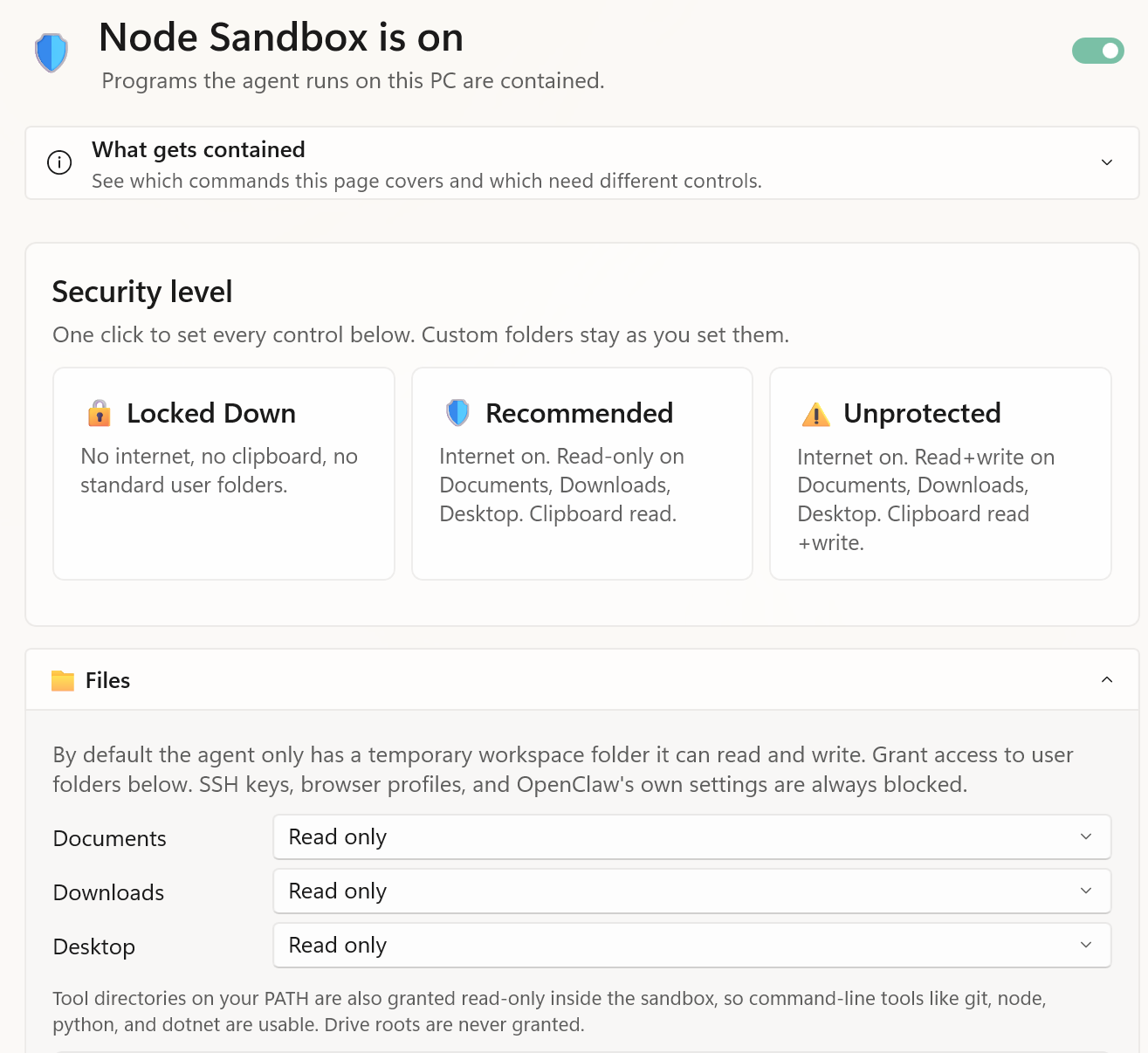
With OpenClaw Windows App latest release, we’re introducing managed local AI through llama-server, alongside an updated llama.cpp runtime and further improvements to startup reliability, generation limits, model availability, and routing safeguards.
For enterprises, these advancements further make it possible to run autonomous agents with stronger security, governance, and visibility, while also reducing dependence on cloud inference.
Easier ≠ less powerful
OpenClaw started as a project built for someone very comfortable with computers, and for the people who want that advanced path, it’s all still here. Run it locally. Pick your model. Connect your own tools. Change how it works. Give it more authority, or less.
None of that gets watered down by being easier to reach, and neither does your security. Whether you’re on a Mac or a Windows NVIDIA RTX PC, a clearer setup lets you decide what OpenClaw has the keys to.
We’re continuing to improve what trustworthy agent execution looks like at scale. But we believe agents should be powerful without requiring you to give up control of your devices, data, or infrastructure. An installer on macOS, simpler local setup on Windows NVIDIA RTX PCs, and built-in containment are steps in that direction.
And for those who are new, eager, and ready to build — those who care not for terminals and gateways — this next chapter gets you to powerful agents, faster.
Welcome. 🦞