

A year ago, people were still debating YOLO mode in coding agents. Some people even thought that coding agents themselves were the future form factor of AI. “Everyone will just use the terminal to do everything”, said your techiest friend. Thankfully the terminal has mostly been relegated to where it belongs and chat has become the default.
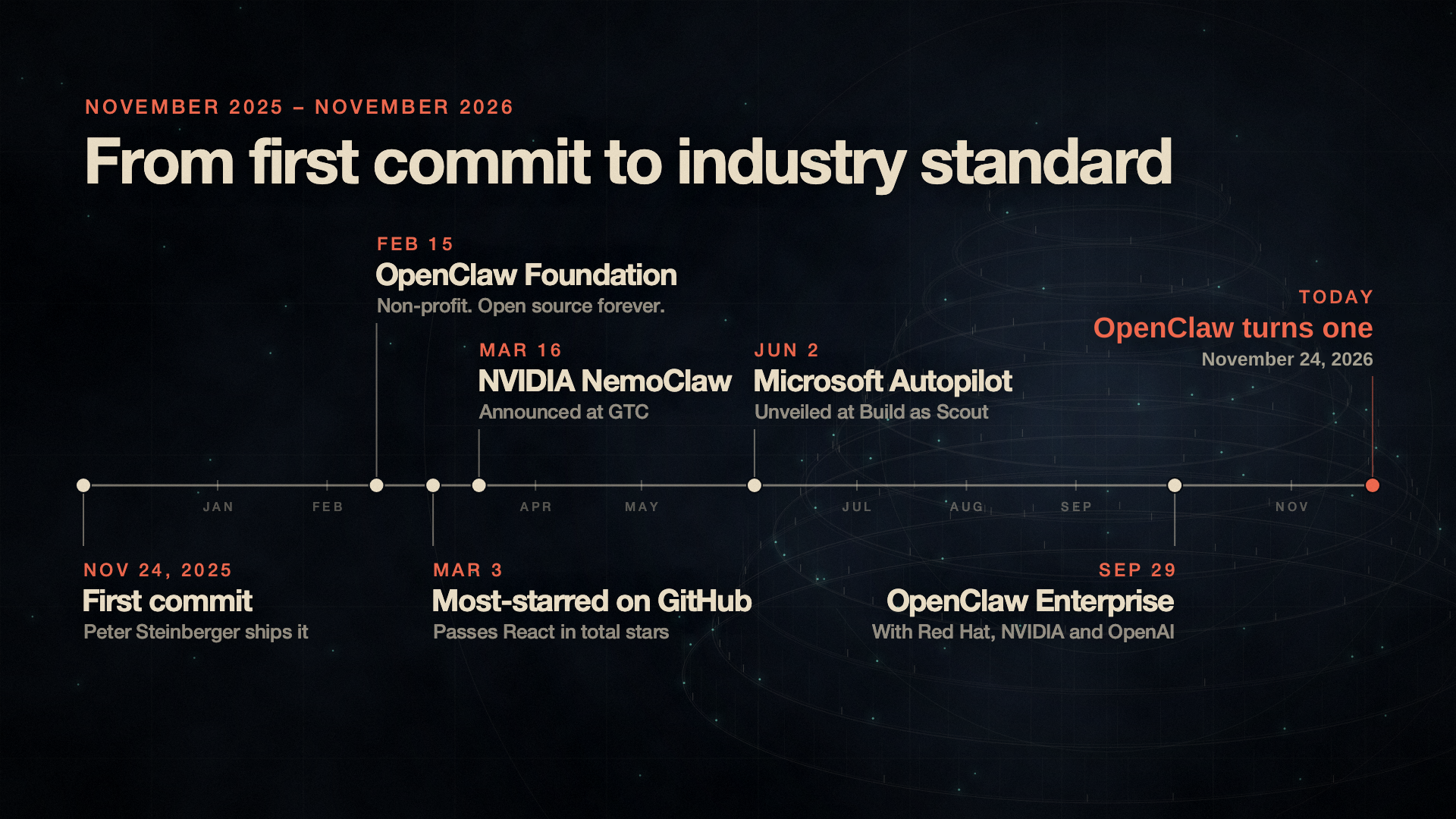
In the last year, the shape of how users are going to interact with AI has largely been defined as what Peter Steinberger shipped on November 24th, 2025. Since then every major AI company has shipped product that looks like OpenClaw. What’s more telling that the agentic era has arrived is that banks, airlines, and major e-commerce platforms have all come out with anti-AI agent policies.
Community and Impact
Ever since that first commit, the OpenClaw community has grown like nothing else in history. It became the largest open source project ever, millions of users have installed and used our software. The largest enterprises on earth have made OpenClaw part of their core offerings, and many of the primitives that OpenClaw pioneered have become standard operating procedure for the newest crop of consumer products.
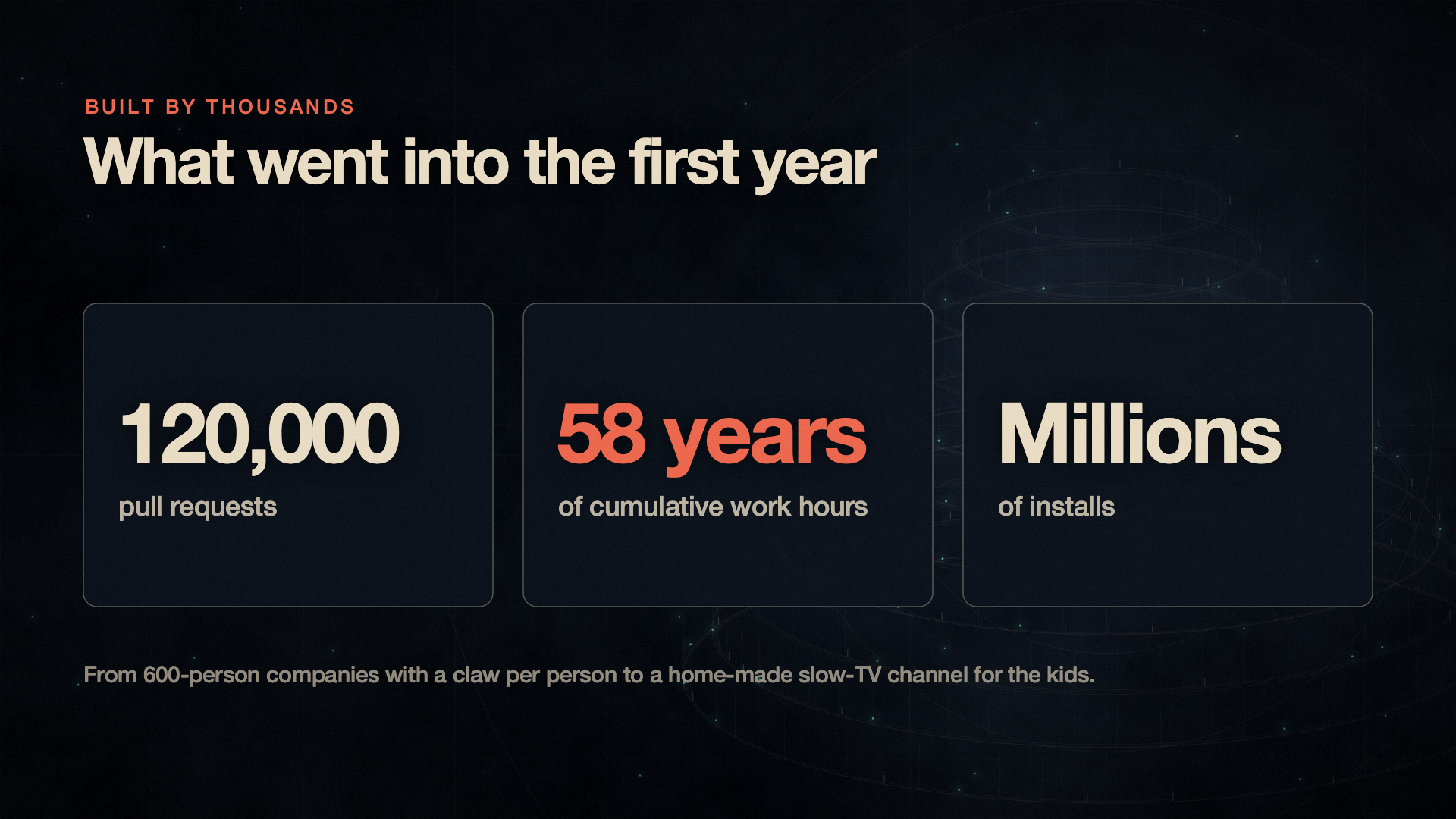
What’s more important than the influence of a single man is the influence of the thousands of people who’ve contributed to OpenClaw. The 120,000 pull requests and 58 years of cumulative work hours that have gone into the project. The use cases from running 600 person companies where each person has their own claw to someone building their own TV channel so their kids can watch slow television. Open claw has enabled people, not just developers, to use the computer fully as a medium of expression.
Empowering Creative Expression
It was once the case that if you wanted to express yourself as a video editor, graphic designer, web developer, app developer, CAD designer, 3D printer, or sound engineer, you’d have to spend years learning the tooling and perfecting your craft. But that’s no longer the case. Anyone can fully express themselves using every capability that modern computers have on offer.
These advancements are made possible by the improvements in the models. The ability for anybody to own and build custom workflows on top of these models has been made possible by open claw. Decades after the personal computer became ubiquitous in Western society, the ability to use it to its limit has finally reached its final form.
OpenClaw became a standard, now we’re pushing the frontier again
What comes next is anyone’s guess. But at the Open Claw Foundation, we have a few ideas. Over the last year, single player AI agents have become the de facto standard. The biggest companies in the world have built on OpenClaw. Microsoft has shipped Autopilot to their customer, and NVIDIA has shipped NemoClaw. In September RedHat, OpenAI, NVIDIA and more came together to build OpenClaw Enterprise, an open standard for shipping persistent agents in enterprise environments.
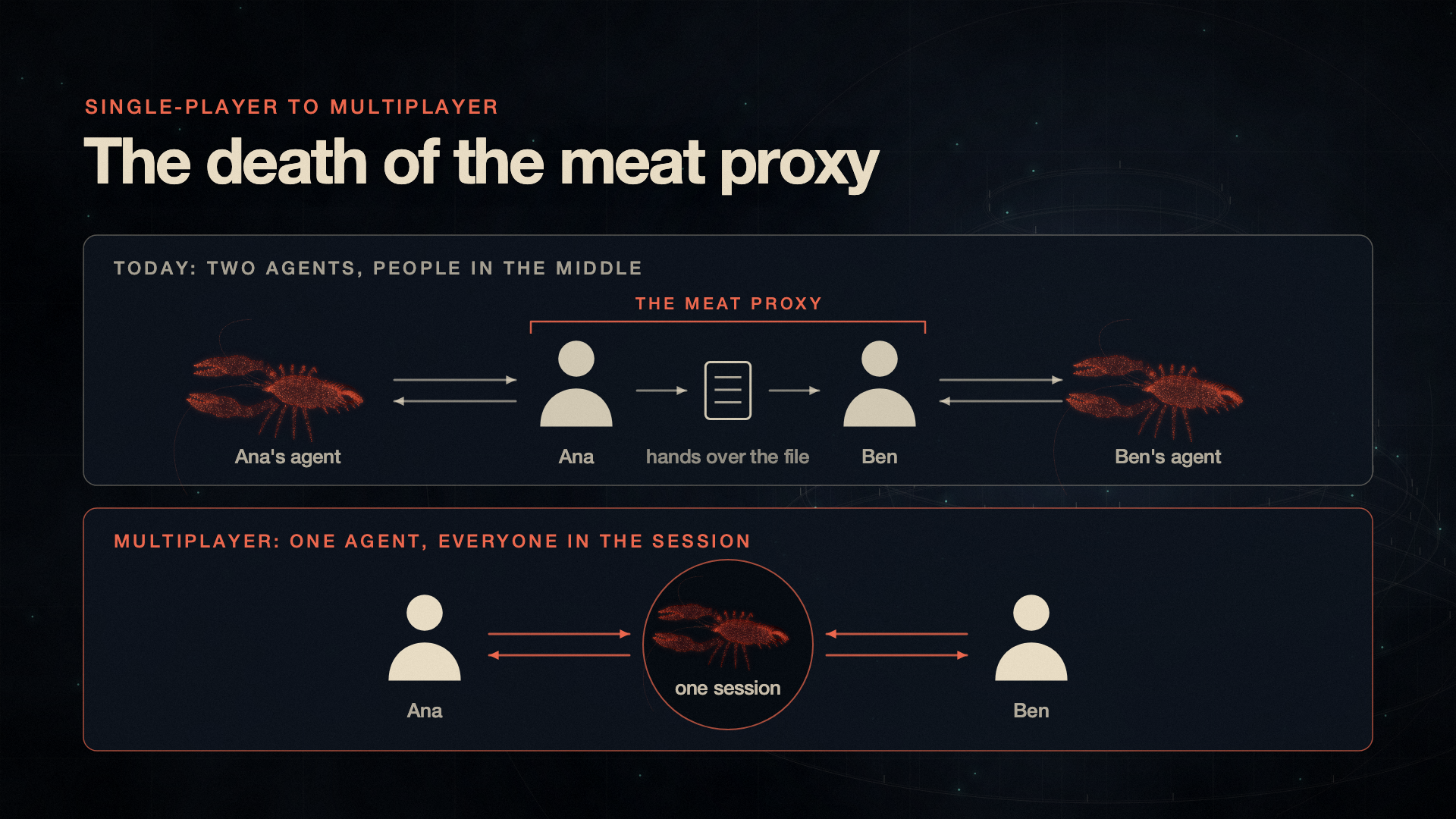
What’s coming next is multiplayer AI or, “the death of the meat proxy”, as we call it. For those of you unfamiliar, meat proxy is the phenomenon of one user working with their agent to generate an artifact, handing that artifact over to another user, and then that second user giving the agent the artifact and continuing to work on. This is inefficient and slow.
The future of human agent collaboration
At OpenClaw, we’ve been working on a multiplayer experience different from what other agents are offering. For example, many agent platforms are allowing your agent to connect with other agents, but we think that’s fundamentally flawed. At OpenClaw, our multiplayer experience is a single agent with sessions that multiple users can join. We’ve been using OpenClaw in multiplayer to build OpenClaw for the last few months, and it has not only increased the speed with which our core team develops, but also the way that we’ve collaborated with guest maintainers and claw contributors in our community.
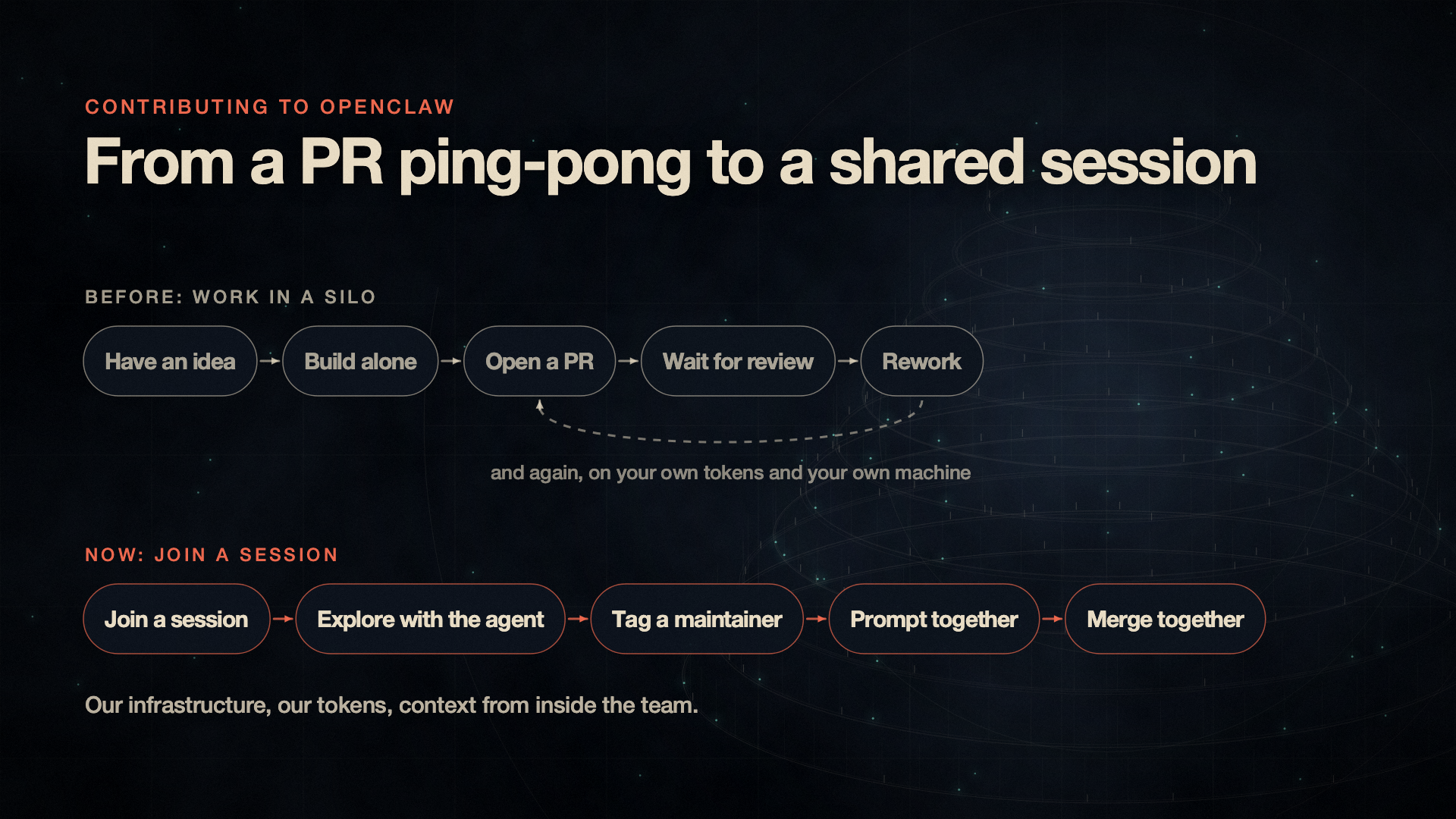
If somebody has an idea, they no longer have to work in a silo, ship a PR, get a review, go work again, and make another PR for the cycle to repeat itself. They can join a session, ask the agent questions, start to explore the shape of the idea, and tag someone on the OpenClaw team to join them and give context from inside the organization. When those two have figured out the shape of the idea together, they can prompt the agent together, iterate together, and make a pull request and even merge it together. Contributors don’t have to spend their own tokens. They don’t have to test locally. They can take advantage of all of our infrastructure and just do what they wanted to do in the first place, improve the tool that they love.
Redefining Team Dynamics
We think that OpenClaw, when used in multiplayer, is the future of how not only products get built, but how users interact with companies. Why file a support ticket when you can just fix the problem yourself? Why talk to a salesperson when you can just ask the product all the questions you need, and even get a demo instance built for you in your specific use case.
We’re just scratching the surface of how multiplayer AI is going to change the way that people and teams work. And we’re still figuring out exactly what the shape of the offering needs to be, but we’re getting really close. If you have some ideas on how we can make Multiplayer better we’d love to have you join us for a focus week and make some contributions!
Security Has been a big focus
Becoming the world's largest open source project has not been without its controversies. One of the earliest and most persistent controversies to follow around the OpenClaw project has been security. When you're the first project that gives AI unfettered access to a person's computer, you're going to find edge cases and issues that are worrisome. Luckily, the OpenClaw Foundation has Josh Avant, who has led the efforts to make OpenClaw secure and recently led OpenClaw's work on the Trail of Bits audit that came back with an extremely positive report.
In September, Trail of Bits conducted that audit through OpenAI's Patch the Planet initiative. But as we all know, and especially from recent weeks, security is a ongoing battle. But we're confident that between our team's efforts and the eyes of the broader community, OpenClaw continues to be a safe and secure platform not only to use but to build on top of.
Looking Ahead
The OpenClaw Foundation exists to make leading edge AI accessible to everyone for free. We’re always looking for partners who want to bring that vision to the world and contributors who want to be part of it. Thanks for joining us on this journey. We look forward to building the future of agents with you in the years to come.